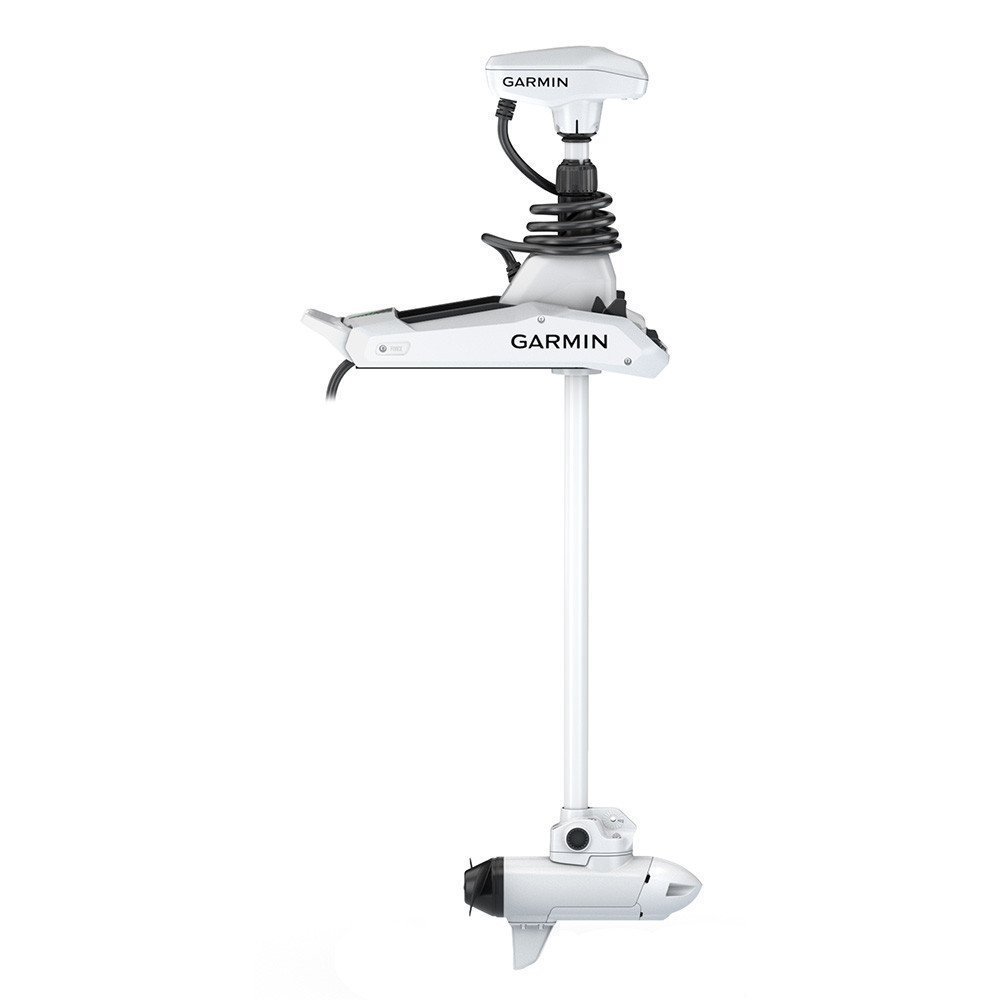
The three specifications that determine whether a trolling motor fits a boat are thrust, shaft length and operating voltage. Thrust must move the fully loaded vessel in expected wind and current. The shaft must keep the propeller submerged. Voltage determines the battery bank, cabling and charging system required.
How much trolling-motor thrust do you need?
Trolling-motor power is rated in pounds of thrust rather than horsepower. Boat length is a useful starting point, but total weight is more meaningful. Include the hull, engine, batteries, fuel, passengers, tackle, water and other gear.
| Total boat weight | Typical minimum thrust range | Common voltage |
|---|---|---|
| Up to 1,599 lb | 30–40 lb | 12V |
| 1,600–2,599 lb | 40–55 lb | 12V |
| 2,600–3,599 lb | 70–80 lb | 24V |
| 3,600–4,599 lb | 80–90 lb | 24V |
| 4,600 lb and above | 112–115 lb or application-specific | 36V |
These ranges are general starting points based on manufacturer guidance, not substitutes for the specific motor manual. Deep-V hulls, high freeboard, strong current and offshore conditions can require additional thrust. Large-vessel applications should be checked with the manufacturer or an experienced installer.
Choosing trolling-motor shaft length
A short shaft can allow the propeller to break the surface in waves, causing noise, loss of thrust and poor control. An unnecessarily long shaft can increase draft and create mounting or stowage problems.
For a bow mount, measure vertically from the top of the mounting surface to the waterline. Minn Kota’s general guidance recommends keeping the center of the motor section at least 12 inches below the waterline and adding length for rough water or specific hand-control installations.
| Bow to waterline | General shaft-length starting point |
|---|---|
| 0–10 inches | 36 inches |
| 16–22 inches | 42–45 inches |
| 22–28 inches | 48–52 inches |
| 28–34 inches | 54–60 inches |
| 34–52 inches | 72–87 inches |
Always consult the selected motor’s measurement diagram. Mount design, trim, bow rise and actual loaded waterline can change the required length.
12V vs 24V vs 36V trolling motors
- 12V: commonly used for lower-thrust applications and requires one 12V battery.
- 24V: commonly powers medium-thrust motors and normally uses two 12V batteries wired in series.
- 36V: supports high-thrust systems and normally uses three 12V batteries wired in series.
Some newer motors support more than one voltage, but this must be explicitly stated by the manufacturer. Never infer multi-voltage compatibility from thrust alone.
Battery capacity, wiring and circuit protection
Voltage tells you the number of series-connected batteries; amp-hour capacity influences operating time. Runtime varies with speed, wind, current, boat weight, battery condition and charging practices. Frequent high-thrust operation drains the bank much faster than low-speed positioning.
Use the motor manufacturer’s conductor-gauge and circuit-breaker table. Longer cable runs may require larger conductors to control voltage drop. Protection must be sized for the exact motor, voltage and maximum current—not chosen from a generic boat-wiring rule.
Freshwater vs saltwater trolling motors
Saltwater models typically use corrosion-resistant materials, coatings and hardware intended for marine exposure. A freshwater-only motor should not be assumed suitable for saltwater use. Even with a saltwater model, rinse and maintain it according to the manufacturer’s instructions.
Bow mount, transom mount or engine mount?
- Bow mount: precise pulling control and common advanced GPS-positioning features.
- Transom mount: simple installation for smaller boats, tenders and portable use.
- Engine mount: preserves deck space but has application-specific compatibility.
Features that may justify upgrading
- GPS anchor or position-hold function
- Route recording and automatic navigation
- Wireless or foot-pedal control
- Brushless motor technology
- Integration with a compatible fishfinder
- Lift assist and secure stowage
- Built-in sonar transducer
Trolling-motor installation checks
Before drilling the deck, cycle the mount through deployment and stowage and verify clearance from rails, anchors, hatches and navigation lights. The motor head, shaft and propeller must clear the hull throughout operation. Reinforce the mounting surface when required and use corrosion-compatible fasteners and sealant.
Route power wiring separately from sensitive electronics where practical, protect cables from abrasion and follow the specified fuse or circuit-breaker location. Batteries must be secured, ventilated where applicable and connected with the polarity and series arrangement shown in the manual. After launching, confirm shaft depth, steering direction, GPS calibration and full-range operation under load.
Compare freshwater and saltwater trolling motors for different boat sizes.
Frequently asked questions
Is more trolling-motor thrust always better?
Extra margin can help in wind and current, but it also adds battery, wiring, charging, weight and cost requirements. Stay within the motor and boat manufacturer’s recommendations.
How many batteries does a trolling motor need?
A conventional setup normally uses one 12V battery for 12V, two in series for 24V and three in series for 36V. Confirm the exact model manual.
How deep should the trolling-motor propeller be?
Manufacturer guidance commonly targets at least 12 inches of submersion for the center of the motor section, with additional depth for waves and specific installations.
Can I use a freshwater trolling motor in saltwater?
Only if the manufacturer explicitly approves it. Saltwater models are designed with corrosion protection appropriate to that environment.
Continue planning your system: choose a compatible display with our marine GPS chartplotter guide and review charging equipment in marine battery chargers.
Technical references: Minn Kota motor selection and boat-size guide and battery and wiring guide.