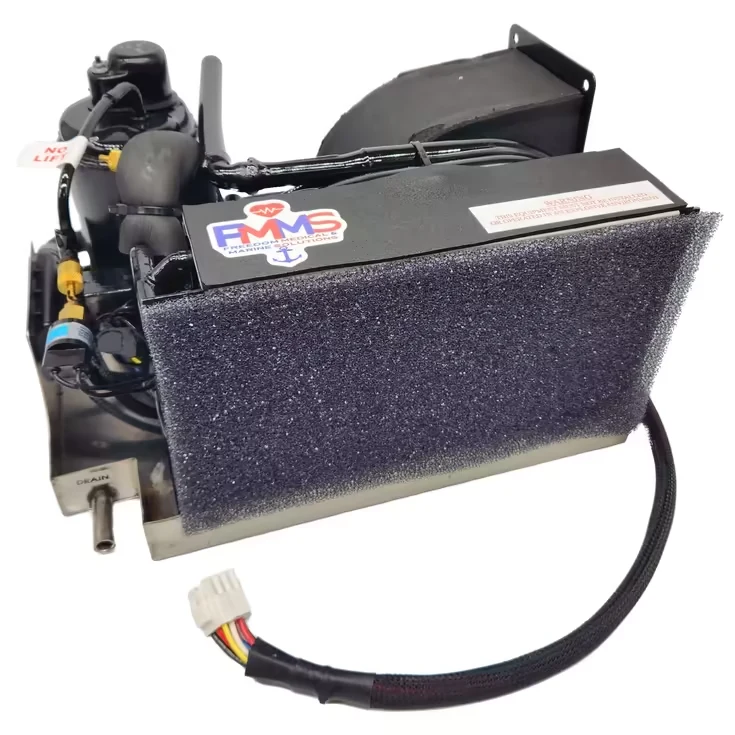
Marine air-conditioner sizing begins with cabin area, but square footage alone is not enough. Direct sun, windows, hull insulation, tropical water, occupancy, machinery heat and airflow can change the cooling load substantially. An undersized unit may run continuously; an oversized unit can cycle too quickly and control humidity poorly.
How marine AC capacity is measured
Cooling capacity is normally stated in BTU per hour. Dometic notes that 1 kW of cooling capacity is approximately 3,412 BTU/h. Capacity should not be confused with electrical input power. A 12,000 BTU/h unit does not consume 12,000 BTU of electricity; it is rated for heat removal under specified test conditions.
Step 1: calculate each cabin’s area
Measure length by width at a representative midpoint, then separate the vessel into zones that need independent temperature control. A closed sleeping cabin, an open salon and a pilothouse with large windows should not be treated as identical spaces.
Step 2: apply a climate and location factor
| Location | Temperate climate | Tropical climate |
|---|---|---|
| Below deck, limited glass | About 60 BTU/h per sq ft | About 90 BTU/h per sq ft |
| Mid-deck, some windows | About 90 BTU/h per sq ft | About 120 BTU/h per sq ft |
| Above deck, large glass/direct sun | About 120 BTU/h per sq ft | About 150 BTU/h per sq ft |
These are planning factors derived from Dometic’s selection guide and assume typical headroom and furnishing. They are not a final engineering calculation. Add appropriate margin for unusually large windows, poor insulation, frequent door opening, crowded cabins or hot machinery spaces.
Marine AC sizing example
Consider a 120 sq ft mid-deck salon used in a tropical climate:
120 sq ft × 120 BTU/h per sq ft = 14,400 BTU/h
That estimate falls between common equipment sizes. The final choice should consider real seawater temperature, glass exposure, air distribution, generator capacity and whether adjacent spaces are open. Do not simply round down to reduce purchase cost.
Common marine air-conditioner sizes
| Nominal capacity | Common application | System checks |
|---|---|---|
| 6,000 BTU/h | Small sleeping cabin | Compact duct and grille requirements |
| 9,000–10,000 BTU/h | Medium cabin or efficient compact salon | Verify startup load and return-air path |
| 12,000 BTU/h | Larger cabin or moderate salon | Check seawater flow and 6-inch-class duct guidance |
| 16,000–18,000 BTU/h | Large salon or high-load zone | Greater airflow, power and grille area required |
Applications vary too widely for capacity alone to identify the correct unit. Match the specific model’s dimensions, voltage, frequency, current draw, cooling/heating configuration and installation manual.
115V, 230V and frequency compatibility
Confirm the vessel or shore-power voltage and frequency. Equipment intended for 115V/60Hz is not interchangeable with 230V/50Hz equipment. For international cruising, shore-power conversion and generator output require careful engineering. Never assume a voltage label alone guarantees frequency compatibility.
Starting current and generator sizing
Compressors can require a much higher current during startup than while running. Consider every simultaneous load: battery chargers, water heaters, galley equipment, pumps and additional AC zones. A soft-start device may reduce starting demand when approved for the selected system, but generator and wiring calculations still need to follow manufacturer requirements.
Seawater flow and cooling performance
Water-cooled marine systems depend on unrestricted seawater flow. Dometic’s guide uses a general rule of roughly 250 gallons per hour per 12,000 BTU/h of capacity. The exact pump, strainer, seacock, manifold and hose arrangement must follow the unit instructions.
Warm seawater reduces the system’s ability to reject heat. Dirty strainers, air locks and restricted hoses can reduce performance and raise power consumption. Design service access so the strainer and pump can be inspected safely.
Ducting and return-air design
Good airflow is essential. Keep discharge ducting short, smooth and free of unnecessary bends. Size supply and return grilles for the unit. The return path must remain open, and the system should never draw vapors from a bilge or engine room.
Self-contained vs split marine AC
- Self-contained: compressor, condenser and blower in one cabin unit; practical for individual zones but places operational noise in the accommodation space.
- Split system: separates condensing equipment from air handlers; useful for larger multi-zone vessels but requires more refrigerant, plumbing and installation planning.
Pre-purchase checklist
- Area and deck level of every zone
- Temperate, tropical or extreme operating climate
- Window area, insulation and direct-sun exposure
- Required BTU/h capacity
- Voltage and frequency
- Running and startup current
- Seawater pump, strainer and flow requirement
- Duct and grille dimensions
- Condensate drainage and service access
Browse marine air conditioners by capacity, voltage and cooling configuration.
Frequently asked questions
How many BTUs does my boat need?
Calculate each zone by area, climate and deck position, then adjust for windows, insulation, occupancy and heat sources. A qualified installer should confirm the final load.
Can a marine air conditioner be oversized?
Yes. Excess capacity can cause short cycling and inadequate humidity control, while also increasing electrical and installation requirements.
Can I use a household air conditioner on a boat?
Marine systems are designed around vessel power, corrosion exposure, movement, condensate management and, for water-cooled systems, seawater circulation. Use equipment approved for the intended marine installation.
Why does marine AC cool less in very warm water?
The condenser must transfer heat into seawater. As seawater temperature rises, heat rejection becomes more difficult and system capacity and efficiency can decrease.
Continue planning onboard power: compare marine generators and marine battery chargers for the vessel’s wider electrical system.
Technical references: Dometic marine AC selection guide and capacity and performance overview.