Wakefoiling looks impossible from the dock — a board floating silently above the water with no visible effort. It’s the steepest learning curve in tow sports, and also one of the most rewarding once it clicks. Here’s how to actually get through the learning phase without quitting on day one.
Start on your knees, not standing
Nearly every foiling program starts riders in a prone or kneeling position before ever attempting to stand. This lets you feel how the foil generates lift and how sensitive it is to pitch angle, without also having to balance upright at the same time. Trying to stand up on your very first pulls is the single most common reason beginners give up early — you’re stacking two hard skills on top of each other instead of one at a time.
The core skill: pitch control, not balance
Unlike a wakeboard, a foil doesn’t stay level on its own — small changes in how much you lean forward or back change the foil’s angle of attack and how much lift it generates. Too much lift and the board rockets out of the water and stalls; too little and it drops back down hard. Learning to make small, continuous adjustments rather than big corrections is what separates a wobbly first ride from a smooth one.
Boat speed: much slower than you’d guess
Most beginners foil successfully at just 8–12 mph — significantly slower than wakeboarding or wakesurfing speeds. Going faster doesn’t help early on; it just makes the foil generate lift faster than most beginners can control, leading to the sudden “pop out and crash” pattern that scares people off. Ask your driver to hold it slow and steady, and resist the urge to speed up until you’re consistently stable.
Why wake size barely matters
This is the foil’s biggest advantage over wakesurfing: because the foil lifts the board entirely above the water’s surface, you don’t need a big, shaped wake to ride behind. Smaller boats without ballast or wake-shaping systems, that could never produce a proper wakesurf wave, work fine for foiling.
The most common beginner mistake, explained
Leaning too far back too early. It feels intuitive — pull back to “lift off” — but overcorrecting backward stalls the foil and drops you. Small, forward-centered weight with the foil doing the lifting, not your body pulling up, is the actual mechanism. This single adjustment fixes most repeated early crashes.
Safety gear isn’t optional here
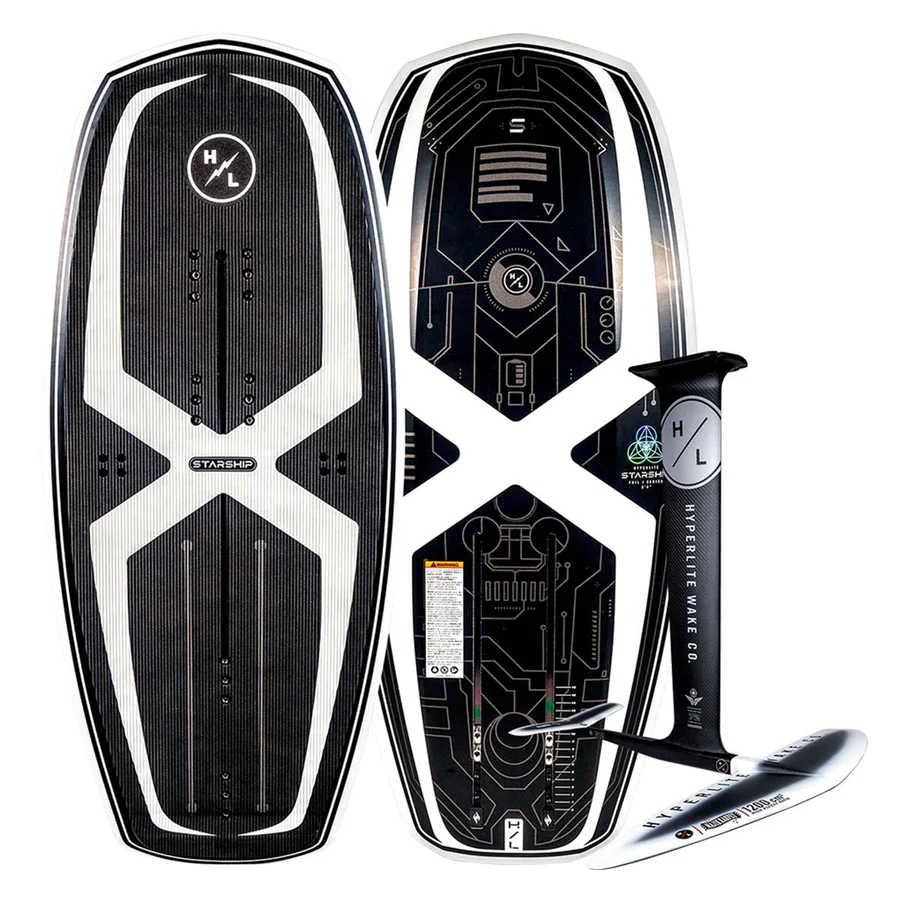
A foil’s mast and wing are rigid and can cause real injury on a fall, especially in shallow or crowded water. A properly fitted impact vest and, for many riders, a helmet are standard for foiling in a way they aren’t always for wakeboarding — practice in open water away from docks, swimmers, and other boats while you’re still learning to control falls.
Once it clicks
Riders consistently describe the same moment — the board suddenly goes silent and smooth as it lifts fully out of the water. Most people who push through the frustrating first few sessions say it’s worth it specifically because nothing else in tow sports feels like it.
Shopping for your first setup? Compare options in our wakefoil category.