
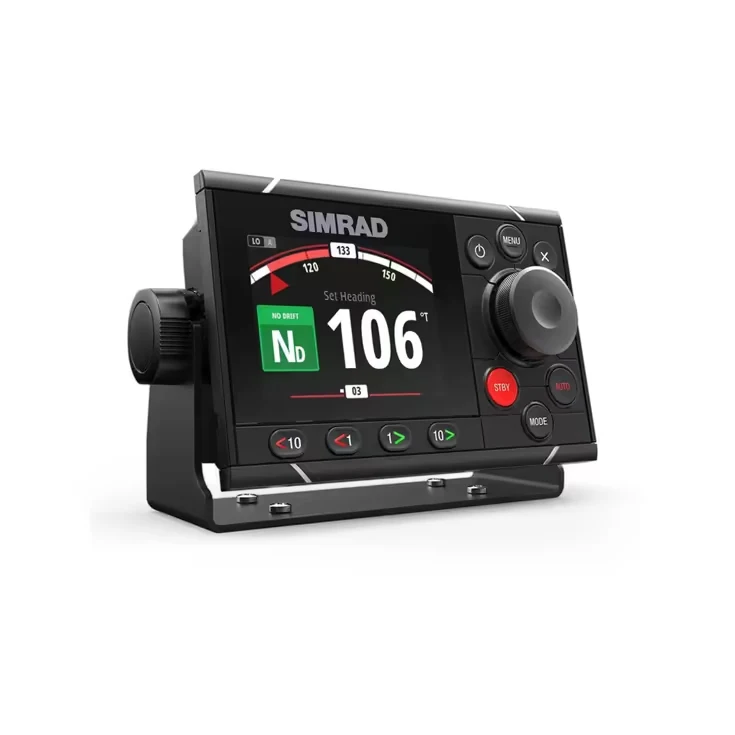
Autopilot promises to steer your boat so you don’t have to — and then, for a lot of new owners, it starts hunting back and forth, overcorrecting every wave, or drifting off course entirely. Almost none of that is a broken unit. It’s setup. Here’s how to actually get it working the way it’s supposed to.
Calibration isn’t optional — it’s the whole system
Skipping or rushing the initial calibration (compass swing, rudder reference alignment, drive response settings) is the single biggest reason autopilots perform badly. An uncalibrated system is guessing at your boat’s actual turning behavior instead of knowing it — every correction after that is a little bit wrong.
Why it “hunts” — constantly overcorrecting
If your autopilot swings past the heading and corrects back and forth in a wave pattern, your response or counter-rudder setting is usually too aggressive for your boat and conditions. Most autopilots let you tune the responsiveness — lower it for calmer water, raise it slightly for boats that need more correction to hold a line in chop. This single adjustment fixes the majority of “my autopilot won’t hold a straight course” complaints.
Sea state changes what “good” settings look like
Settings tuned for flat water often overcorrect in chop, and settings tuned for rough water can feel sluggish and imprecise in calm conditions. Most modern autopilots have a sea-state setting for exactly this reason — adjusting it when conditions change is normal, not a sign something’s wrong.
Hydraulic vs mechanical steering — different setup, different mistakes
Hydraulic systems rely on a pump matched to your steering system’s flow rate — mismatched pump sizing causes sluggish or overly sharp response no matter how well you tune software settings. Mechanical/cable steering systems depend on correct drive unit tension and alignment. If your autopilot behaves erratically despite correct calibration, the mismatch is often mechanical, not electronic. Our autopilot buying guide for hydraulic and mechanical steering covers matching the drive unit to your steering type.
Don’t trust it blindly in traffic or tight water
Autopilot holds a heading or a route — it does not see other boats, markers, or shallow water. Every autopilot manufacturer says this, and every experienced boater has a story about someone who didn’t listen. Use it for open-water passages and disengage for docking, channels, and any area with traffic.
The “it worked yesterday, not today” problem
Sudden erratic behavior after previously working fine usually points to a mechanical or electrical issue — a loose rudder reference sensor, a failing drive unit, or interference near the fluxgate compass sensor (keep it away from speakers and other magnetic sources, same rule as a standard compass) — rather than a software setting needing adjustment again.
Getting the most out of it
Re-run calibration after any major changes — new prop, significant weight changes, or steering system work. A system calibrated for how your boat handled a season ago won’t necessarily be accurate today.
Comparing autopilot systems for your steering setup? Browse our marine autopilots to find one matched to your boat.