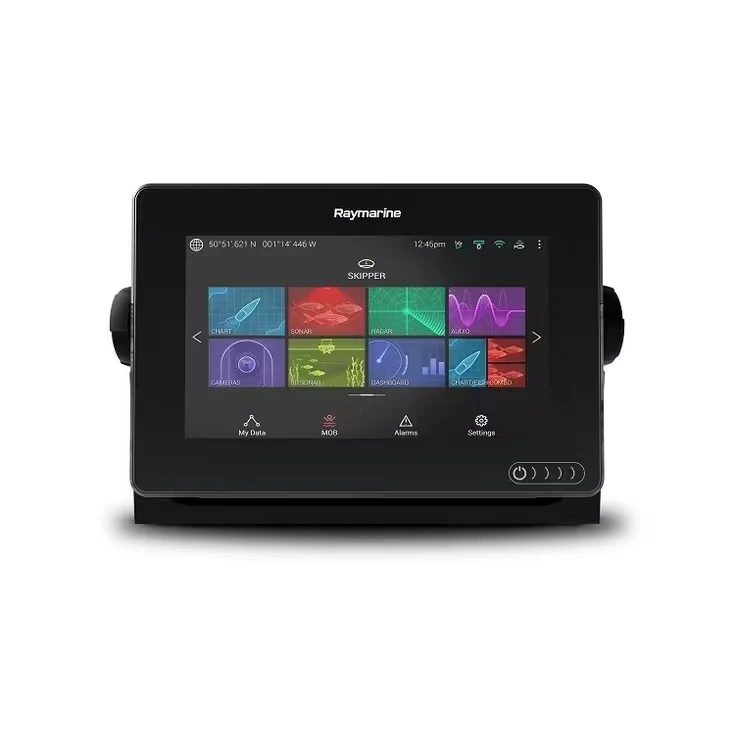
Side imaging vs down imaging comes down to search area. Down imaging concentrates on the water and structure beneath the boat. Side imaging looks outward on both sides, allowing an angler to search a wider strip without driving directly over every target.
Side imaging vs down imaging comparison
| Question | Down imaging | Side imaging |
|---|---|---|
| Where does it look? | Directly below the vessel | To port and starboard |
| Main advantage | Detailed view of bottom and structure under the boat | Wide-area search without passing over the target |
| Screen learning curve | Usually easier | Requires understanding distance and shadow |
| Best operating pattern | Slow, steady passes over structure | Straight, steady survey lines with suitable range |
How down imaging works
Down-imaging systems transmit a thin, high-frequency scanning beam beneath the transducer. The narrow slice can separate branches, rocks and other structure more clearly than a broad traditional-sonar cone. It is useful for confirming what lies directly beneath a waypoint or a suspected target.
Its limitation is coverage. You only see the strip that passes under the transducer, so searching a large flat or shoreline can require many passes.
How side imaging works
Side imaging scans across both sides of the boat. The center of the display represents the boat and the water column; the outer areas represent the bottom extending away from the track. Bright returns and acoustic shadows help reveal the size and shape of objects.
Side imaging is effective for locating drop-offs, timber, rocks and wreck-like structure while covering more water. It performs best when the boat maintains a stable heading and moderate speed. Sharp turns distort the image because the screen assumes a straight survey path.
Frequency, range and image detail
Higher scanning frequencies usually produce finer detail but less range and depth. Lower scanning frequencies can cover farther but may show less fine definition. Set the side range only as wide as needed; an excessive range compresses useful detail into fewer screen pixels.
Do you still need traditional sonar?
For most installations, yes. Traditional CHIRP is often better for continuous depth tracking and watching targets within the cone while moving. Down and side imaging add structural context. Using split-screen views lets each technology do the job it handles best.
Reading shadows and distance
On a side-imaging screen, the dark center band represents the water column between the transducer and bottom. An object may appear as a bright return with a dark acoustic shadow behind it. A longer shadow can indicate that the object rises farther from the bottom, while the distance between return and shadow helps reveal shape. Range markers show how far the return lies from the boat, not necessarily the water depth.
Save a waypoint directly on an interesting return when the display permits it, then approach with traditional or down sonar for a closer look. Repeating the pass from another direction helps distinguish a persistent object from noise or a temporary school of fish.
Conditions that reduce scanning quality
Fast turns, heavy aeration, rough water, excessive range and an obstructed side of the transducer can distort the image. A hull, lower unit or another transducer can block one beam. Before blaming the display, verify mounting clearance and test at a steady speed on a known bottom feature.
Which system fits your fishing?
- Vertical jigging: prioritize traditional CHIRP and down imaging.
- Searching unfamiliar lakes or coastal structure: side imaging can reduce survey time.
- Kayaks and small helms: confirm transducer size, mounting clearance and screen readability.
- Offshore deep water: prioritize suitable traditional CHIRP power and frequency before scanning features.
- Trolling-motor installation: check whether constant steering rotation will make the side view harder to interpret.
Match the display and transducer to your fishing depth, mounting position and required coverage.
Frequently asked questions
Does side imaging show fish?
It can show fish and their shadows, but interpretation takes practice. Structure location is often its clearest advantage.
How far should side imaging be set?
Use a range appropriate to depth and target size. Narrowing the range often makes targets larger and easier to interpret on screen.
Can one transducer provide both views?
Many multi-element transducers support traditional, down and side sonar, but the display and connector must support every function.
Related: read CHIRP sonar explained and fish finder vs chartplotter.
Technical reference: Garmin Scanning Sonar technology.